In 2007 I was a creative director at an agency in Vancouver, and from my desk I could see EA across the street. We made interactive things. They made games. And I kept catching myself thinking the same thought: they must know what fun looks like. Somebody over there has figured it out and written it down.
They had, as it turned out. Game designers had a model for fun with a name and a paper behind it, and a taxonomy of the eight kinds of it. What they didn’t have was anyone carrying it across the street. The game world and the interactive world were a hundred metres apart and had never met. A year later I joined BigPark, a studio Microsoft bought the year after that, and spent the next decade being the person who walked back and forth.
Fun is a curriculum
Here is what I learned, and it took me about six months to believe it: games are fun because they are exceptional teachers.
A good game hands you one skill. You practise it until it’s yours. Then a second. Then a room where you need both at once, and the room is called a boss, and beating it is the exam you didn’t know you were sitting. The feeling that game designers call fun is what the rest of us call getting good at something. Competence, delivered on a schedule, with a story wrapped around it so you don’t notice you’re in school.
And the schedule is the trick. The first skills arrive fast and get rewarded immediately. You go from level one to level ten in an evening. Level nineteen to twenty takes a month, and by then you don’t mind, because you’ve already felt yourself get better and you trust the game to keep its side of the bargain. Front-load the competence. Earn the patience. Every product I’ve worked on since has been a version of that curve, and most of the ones I’ve been brought in to fix had it backwards: a month of setup before the first thing that felt like winning.
Schools noticed. By 2009 a public school in New York had opened with a curriculum built entirely on game design, and a few years later university courses were replacing letter grades with experience points. I was teaching at Vancouver Film School at the same time, which is probably why all of this landed the way it did.
There was a wrong way to carry it across the street, and Jesse Schell described it in 2010 in a talk that’s still worth watching. If game designers ever turned their attention to ordinary products, he said, the whole world would become points and leaderboards, a scoreboard bolted onto your toothbrush. He was right, and it happened, and it was called gamification. What got imported was the scoreboard. What should have been imported was the curriculum.
Seeing fun as a curriculum also changed how I thought about brands. I’d spent years on the agency side treating brand as a feeling, and it is. Nike’s advertising makes you feel like an athlete before you’ve laced anything up. What’s understated is how much work then goes into making that true: the biomechanics, the lab hours, the versions that never ship. The feeling arrives first, from marketing, and the product spends years earning it afterward.
A game runs the other way. The feeling can’t arrive first. It comes from what you did with your hands, and the game has to deliver it in the first ten minutes or there is no second session. Same destination, opposite order. Software mostly borrowed its order from marketing, which is why so much of it feels like a promise the product hasn’t kept yet.
By 2009 we were researching the difference formally. What separated the branded feeling from the loops that actually kept people playing. Why some people need to match things and others need to sort them. Richard Bartle had already divided players into four kinds, achievers, explorers, socializers, and killers, and I still use it, because it explains a failure I’ve watched product teams repeat for fifteen years. They build for the achiever, ship, and wonder where the other three went.
Nir Eyal’s Hooked came out in 2014. That’s not a complaint. It’s a date.
The part the science doesn’t cover
All of that is framework. Rubric, level design, player types, loops. Combine it with the UX work I’d been doing since a persona workshop with Ginny Redish in 2004, outcomes rather than tasks, which I’ll come back to, and you have something powerful. Enough to build a career on.
And something was still missing. I called it the magic moment, because I didn’t have a better word and still don’t. Product people now talk about the aha moment, perceived value, realized value. This isn’t that. The aha moment is when the product makes sense. The magic moment is when it makes you make a noise.
Brian de Haaff has the best description I’ve read of where it lives. In Lovability he calls it the Lovability Line: the point where a customer stops judging you on rational criteria and starts judging you on emotional ones. Utility gets you to the line. Something else gets you over it. He’s precise about what’s on the far side, which is love, and honest that there’s no recipe for the crossing. There isn’t. I’ve looked. But I have watched it happen once, on a kitchen table, and I can describe it.
A tiger, some crayons, a button
In 2010 I co-founded a company called Hoopla and we built a thing called WeGeez. The premise: kids spend fifteen minutes a day on an iPad and the rest of the day outside. On the iPad were creatures from another world who needed help, because they hadn’t looked after their planet. Helping meant geocaching. Real places, real artifacts, real geography, hours with your family hunting for something, and a screen only at the end. Pokémon Go arrived in 2016 with the same bones and a different soul. Ours was a community saving a dying world. Another date.
To test any of it we needed an adjacent product kids would love on its own. It involved children, so it had to be safe, which meant it had to start at the kitchen table or in the back seat on a road trip.
I loved dioramas as a kid. So the idea was: what if a child colours in a creature on paper, and then it’s alive?
Not a photo of the drawing. The drawing, texture-mapped onto a rigged, animated 3D model, in a jungle, on the screen, in the time it takes to press a button.
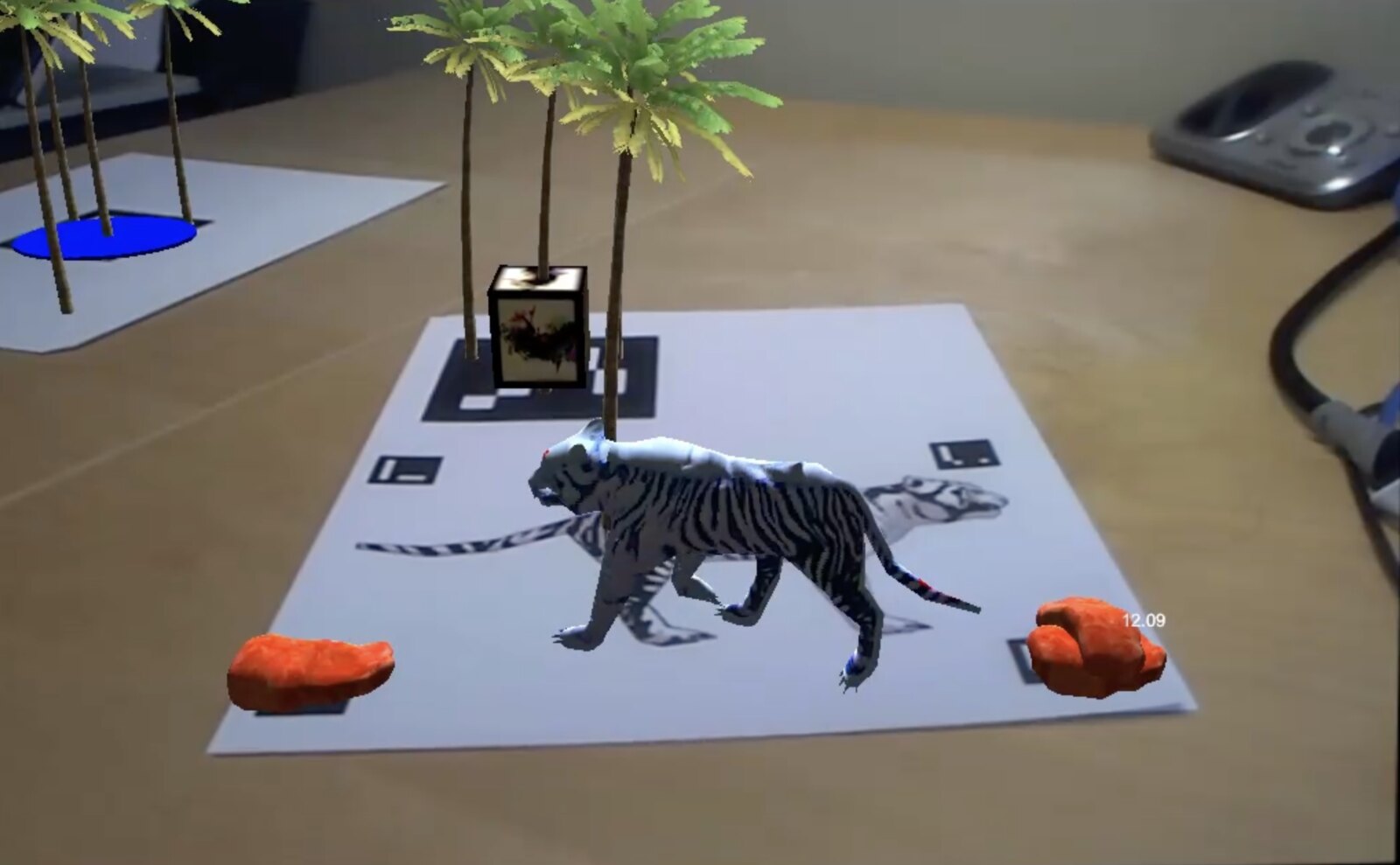
We built it. We tested it. And I’m going to describe the test carefully, because it’s the only evidence I have that magic moments exist.
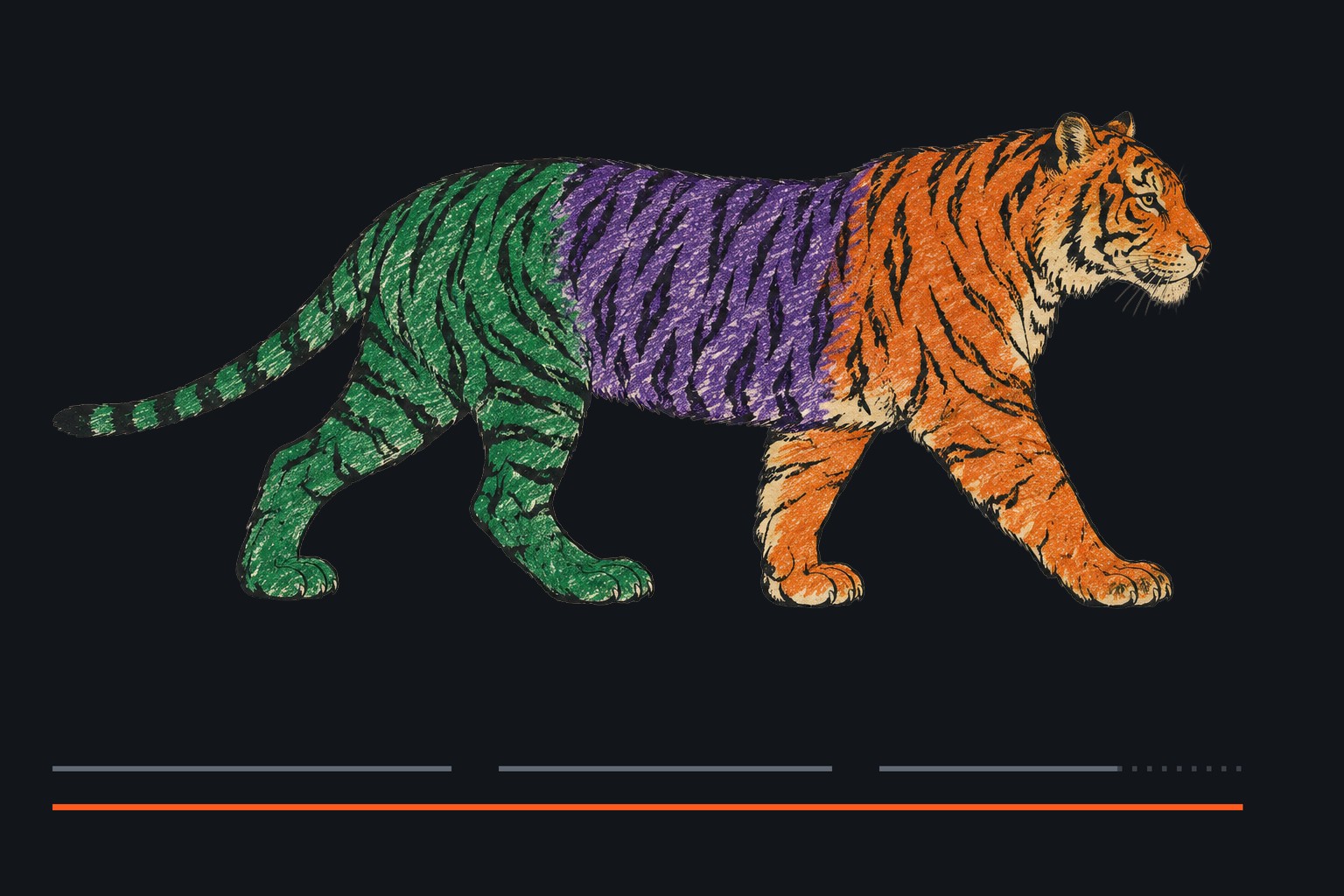
A kid who loves tigers colours a tiger. Green legs, purple back, orange face, because that’s what she had. She holds the iPad over the page and presses the button. And the tiger stands up. Her tiger. Her colours, exactly where she put them, walking around a jungle with the palm trees moving. Then she colours a pond, presses the button again, and the pond is there, and the tiger walks over and drinks from it.
That’s the moment. It’s in the picture below, if you want to see it: the drawing on the paper, and the same drawing standing up, wearing the same colours.
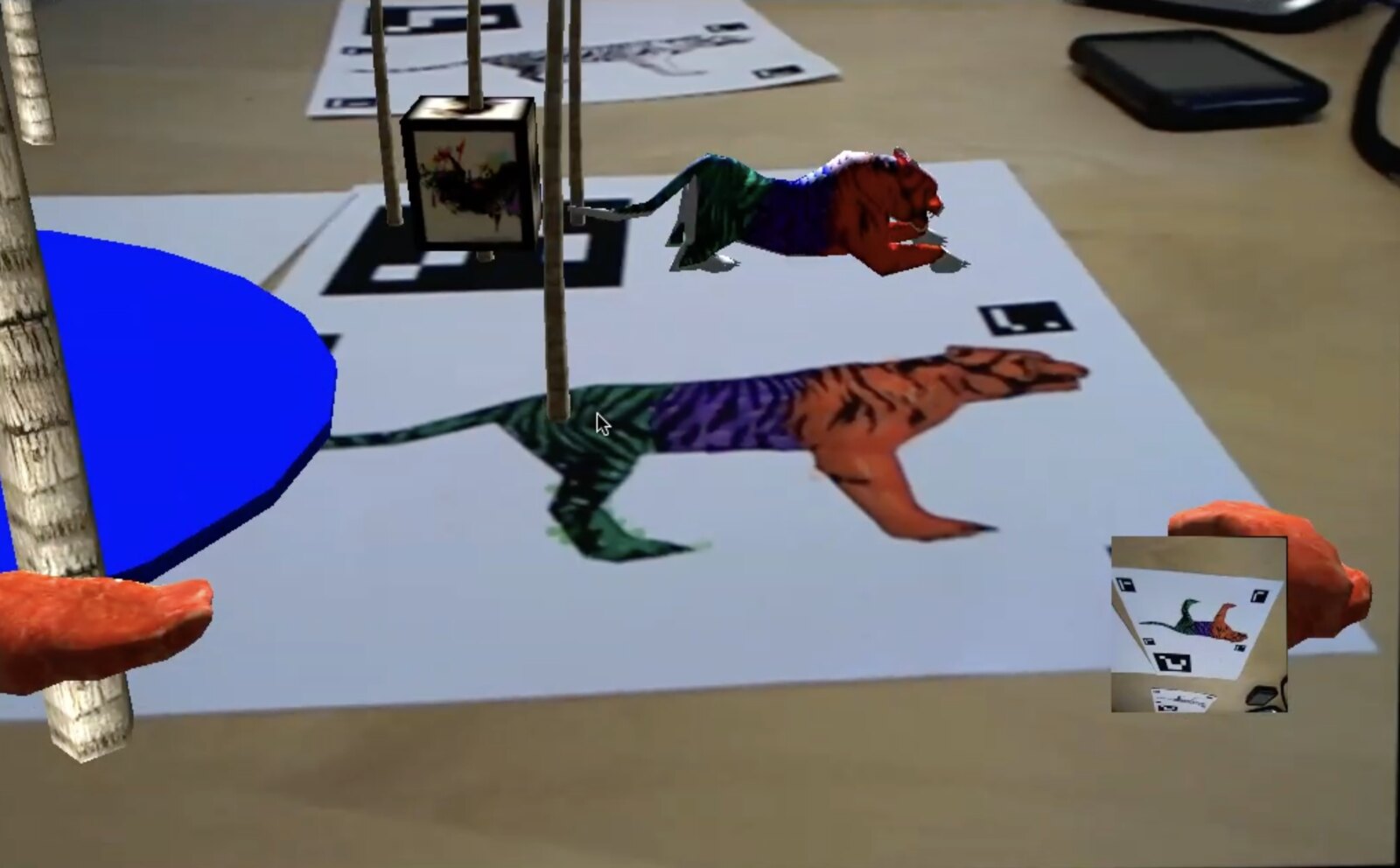
The codename was StickAR. Colouring books of planets, or movies, or whatever you loved, stuck to a bedroom wall, and through the iPad you could see the world you’d made. Kids didn’t like it. They lost their minds. How we taught a camera to recognize a child’s colouring under kitchen lighting, with modified markers and a great deal of computer vision, is a different story and a longer one.
Meanwhile, the industry was drawing a skateboard
While we were doing that, everyone in software was talking about the Minimum Viable Product. Frank Robinson coined it in 2001, and by 2010 it had become the operating philosophy of an entire industry, which is a lot of weight for two adjectives to carry.
Here is how it was actually being used. Ship something crude. If enough people complain, that’s a signal. Fix what they complained about. Repeat.
That works for exactly one thing: finding out whether you can build it at all. Feasibility. IDEO had already said a product needs three things to survive, and feasibility was only one of them, alongside desirability and viability. The research on what makes people value a thing had gone further still: utility, which is whether it solves the problem; pleasure, which is whether it gives you anything back; and craft, which is whether the first two arrive without friction. MVP as practised tested the first. It had no instrument for the other two.
And the engineers, who are not the villains here, heard “minimum” and started talking about components. Which features. Which endpoints. Never which outcome. Ginny Redish had spent a workshop in 2004 teaching me the difference between a task and an experiential outcome, and I watched an entire methodology get built on the task.
The first real correction came from the product-tooling world, not the game world. In 2013 Aha! started using the phrase Minimum Lovable Product, and the argument was simple and right: MVP asks what a customer will tolerate, and business software had been getting away with tolerated for twenty years. Aim for loved instead. That named the target. It was the first framework in the whole lineage that even had a word for the thing I’d been calling magic.
Then in January 2016 Henrik Kniberg published the drawing. You’ve seen it.
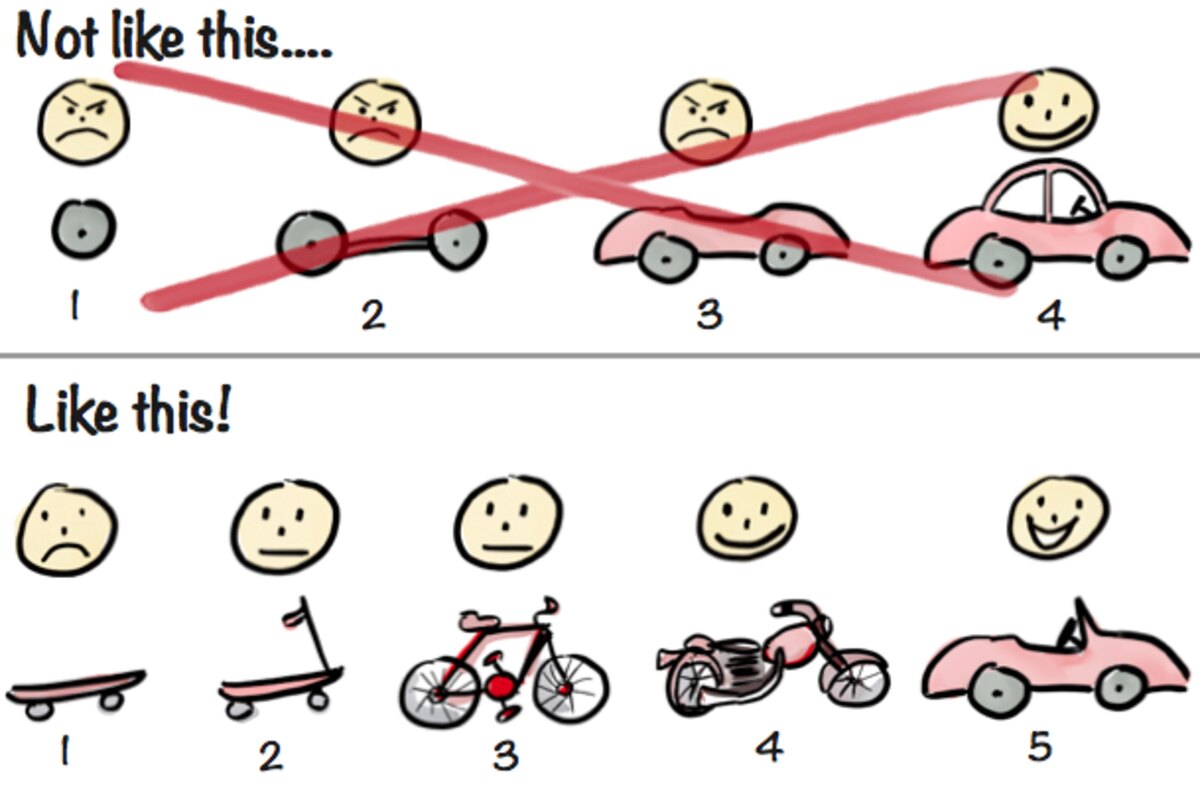
Skateboard, scooter, bicycle, motorbike, car. Don’t build a wheel and call it an MVP; build a skateboard, because a skateboard gets you somewhere. It’s a wonderful drawing. It fixed a misreading MLP had already diagnosed three years earlier. And it still never asked the question. A skateboard is minimum. A skateboard is viable. No one has ever coloured one in, pressed a button, and made a noise.
So the lineage looks like this. MVP tells you what to cut. MLP tells you what to aim for. What’s still missing, from both, is the mechanism. How does a product actually get a person over the line? Not what’s on the other side. How you cross.
The mechanism, as far as I understand it
Here is my answer, and it comes from games, because games are the only discipline that has been building for the far side of the line on purpose for forty years.
The mechanism is a moment of competence the person didn’t expect to have. The kid didn’t think she could make a tiger walk. Then she did, with her own hands, in her own colours. That’s not delight in the abstract. It’s the feeling of a skill you didn’t know you’d acquired, arriving all at once. Which is the same thing that makes a boss fight fun, and the same thing a Nike ad promises before the lab has to make it true. Except here there was no ad and no lab. She made it true herself, in about four seconds.
It’s also the curve. The tiger was level one to level two in a single press of a button. Everything after, the pond, the wall, the planets, was the game keeping its side of the bargain. Most software asks you to reach level nineteen before it lets you feel anything, and then wonders why you left at level four.
Game designers have a model for building toward that. It’s called MDA and it’s been around since 2004. Mechanics are the rules. Dynamics are what happens when people play by them. Aesthetics are what it feels like. The designer builds in that order. The player experiences it in reverse: they feel the aesthetics first and never see the mechanics at all. Which is precisely the problem with MVP. It’s a mechanics-first method being used to guess at an aesthetic. And it’s the gap in MLP, which names the aesthetic and stops there.
So a prototype, in my vocabulary, is the thing you build to remove the downstream risk that the experience won’t be worth anything. Not the risk that it can’t be built. The risk that nobody will love it. That is a different prototype from the one most teams build, and a product, technology, and design group has to agree to build it on purpose, because on a roadmap it looks like a detour, and it’s the only part of the roadmap that decides whether the rest was worth doing.
The rest is discipline. A framework, not rules, for how a team generates ideas and tests them. Roadmaps with room for those prototypes, and the debt paydown that keeps one from becoming the product by accident. Bartle’s four types on the wall, so somebody in the room asks who we’re not building for. And the tiger, as the standard. Not “does it work.” Not even “is it lovable,” which is a judgement made after the fact. Does it make a noise.
Back to the street
I’ve thought about that view of EA for nineteen years, and I had the question wrong. It was never what does fun look like. It was what would make a person press the button a second time. Games knew. A seven-year-old with a purple crayon knew. Most software still doesn’t, and it isn’t because the frameworks are bad. One of them tells you what to cut. A better one tells you what to aim for. The work is everything in between, and it starts with something a child can colour in.
Miles Nurse has been Chief Product Officer four times and a designer the whole way through.
If your product’s first win is a month in, I’d like to hear about it. miles@remarkable.work
* The tiger at the top was generated with ChatGPT from a prompt describing her colours. It is not the original; that one is on the kitchen table above.